


Ayesha tapped the coordinates into her tablet, eyes narrowing. The buried site lay just south of the iconic Step Pyramid at Saqqara, within a restricted zone long left untouched. This area was steeped in myth—rumors among local Bedouins spoke of a hidden temple beneath the sands, cursed by ancient priests who feared its contents. Some even whispered that pharaohs had forbidden further excavation there, fearing it led not just to the underworld but to "the beyond." Though officially dormant for over a decade, the site’s silence seemed more intentional than accidental. Yet, as Ayesha cross-referenced forgotten expedition logs and layered them with recent satellite imagery, inconsistencies emerged—shadowed outlines, unusual heat signatures, and hollow substructures unaccounted for in any official record.
"There's something underneath the shifting dunes here," she muttered. “Cavities where there shouldn't be. Chamber-shaped anomalies.”
They were in Ayesha’s makeshift workshop now—her former apartment transformed into a command center of historical inquiry. Shipping crates were still stacked against the walls, filled with field journals, annotated manuscripts, and aging scrolls she had flown in from Cairo and Luxor. Dozens of photographs from tomb sites littered the tables, alongside open laptops displaying heat maps and spectral scans. Amir’s sketches were pinned across a large corkboard like puzzle pieces awaiting meaning. He stood by the window, fingers smudged with charcoal, sketching again—his hand moving with uncanny fluidity, as if channeled by something beyond him. Maps were spread across the floor, layers of ink and satellite overlays connecting dots that defied coincidence. The air was thick with incense and aged parchment, a cocoon of obsession and wonder. This wasn’t just research anymore. It was a convergence.
Ayesha glanced at his page.
A spiral. Then an eye. Then six stars.
Ayesha is concerned, not just by the intensity of Amir’s visions, but by the way his mind seems to drift untethered—directionless yet dominant. He moved with purpose, but never spoke of a plan. The drawings, the symbols, they erupted from him as if manifesting through some unseen command. His body was merely the conduit. It was as if something ancient had taken root in his subconscious and now guided his hand with each stroke. She watched him with a mixture of awe and apprehension, wondering whether he was truly discovering something, or being used to reveal it.
“You keep drawing those stars,” she said.
Amir didn’t stop. “They whisper. Like a pull. I don’t know how else to explain it.”
“What are they saying?”
“Not words… images. Movements. A sequence. It’s like… like the stars are not above us. They’re below.”
She looked at him, uneasy and intrigued. “Stars below?”
“They form a gate. I saw it. A moment—flashes—when the sand turned to glass and I was falling. The stars weren’t in the sky. They were inside the tomb.”
"The Tomb?" said Ayesha, her breath catching as the realization dawned. She stepped closer, eyes fixed on Amir's trembling form. The image in his drawing was unmistakable—an echo of the cavities she had noticed in her research, the same voids she had dismissed as anomalies.
Now they pulsed with meaning.
"I thought they were geological quirks," she whispered. "But they were cavities... dormant, maybe, but waiting. And now... they're waking up."
He dropped the sketchpad, still trembling.
Ayesha handed him water. “Your sketch is more than just symbols. Maybe it’s a map.”
He turned slowly. “A whispering map.”
***
The next morning, they rented a rickety Land Rover and drove toward the outer Saqqara desert. Heat danced in shimmering ripples across the sand like mirages chasing one another. As they passed the looming silhouette of the Step Pyramid, Amir's breath caught. Something stirred inside him, a vibration, a pull he couldn’t place. His pulse quickened, and his fingers twitched involuntarily—as if an invisible thread had reached out from the pyramid itself and wound itself around him, drawing him toward something long forgotten.
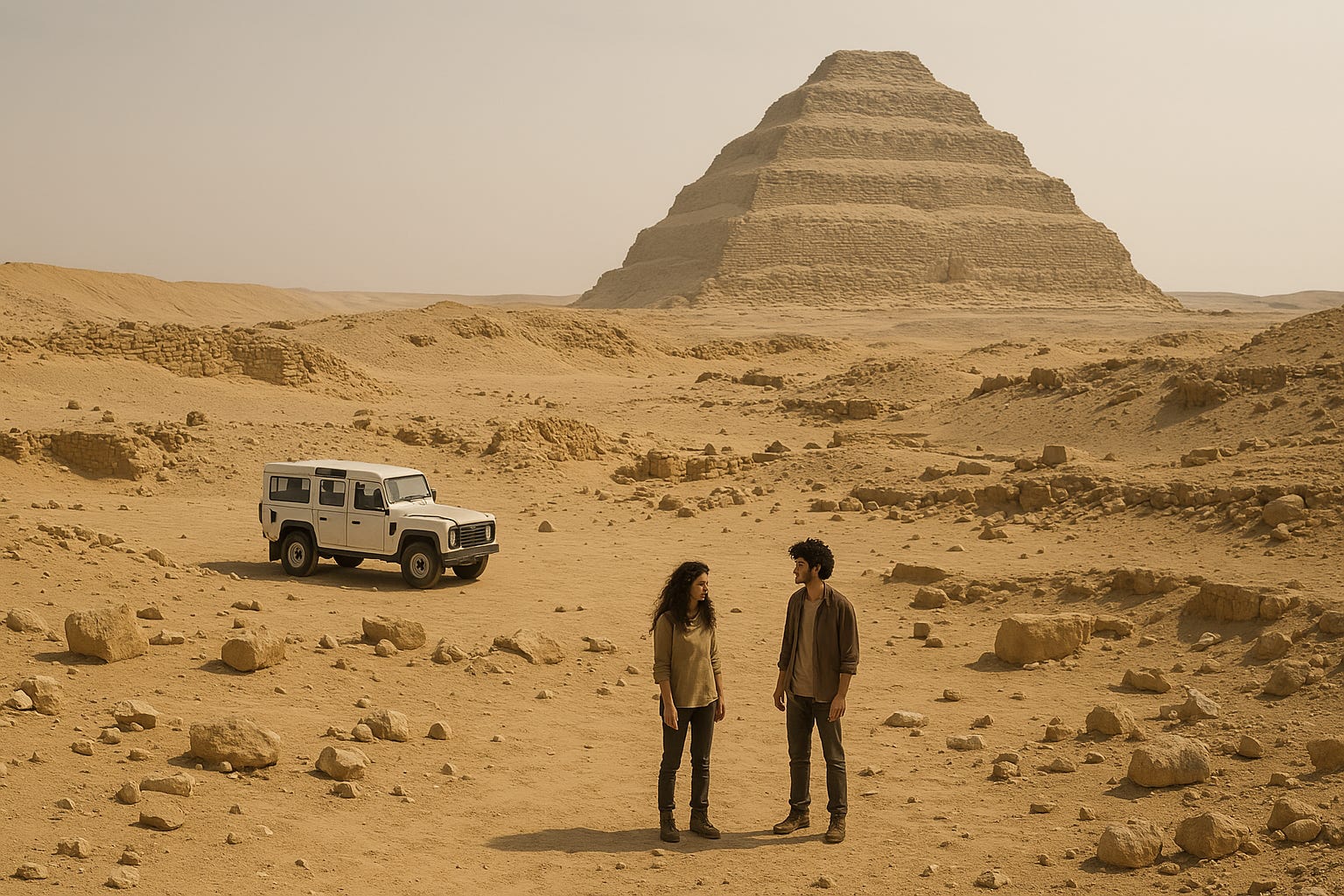
They stopped at a barren stretch, where jagged rock gave way to shifting golden dunes, the landscape shimmering under the oppressive midday sun. Ayesha wiped sweat from her brow and angled her tablet against the glare, her fingers tracing the contours of the satellite overlay once more. She squinted at the screen, cross-checking coordinates with a tattered, annotated expedition map. The ground beneath them held an eerie stillness, the kind that whispered of secrets buried deep. A hawk circled overhead. In the heat haze, the desert almost breathed. “It should be here,” she said, voice low but charged with anticipation.
“Then it is,” Amir whispered.
The wind stirred unnaturally, forming swirling rings in the sand. A small column of air lifted and spun into a spiral, clearing a patch beneath their feet.
Carved stones. Faint hieroglyphs.
Ayesha dropped to her knees, brushing the fine golden sand aside with reverent fingers, each motion slow and deliberate. Her breath caught in her throat—there it was again, unmistakable. The serpent curled protectively around the eye, its body winding in perfect symmetry, more defined than ever before. The eye itself gleamed faintly in the light, its iris adorned with concentric rings and a single dot at the center, almost pulsing. The surrounding sandstone bore faint traces of pigment, as if the symbol had once been painted in vivid hues of lapis and gold. The serpent’s scales were meticulously carved, too refined to be ceremonial—this was meant to last, to speak across time. The entire image felt alive, charged, as if it had only just surfaced from beneath centuries of silence to greet her. Ayesha’s heart pounded with awe and fear. This was no ordinary carving. It was a message waiting to be understood.
Below it, two cartouches.
“This one,” she whispered, “hasn’t been deciphered. It's not in any known dialect.”
Amir stared. “It’s not Egyptian.”
Ayesha blinked, her brows knitting. "Then what is it?" she asked, her voice tinged with disbelief. She had spent years deciphering ancient tongues, yet here stood Amir—an art student—speaking of resonance and memory as if he had touched something older than language itself. Her academic pride wrestled with genuine curiosity.
Amir didn’t look up. His fingers lingered on the glyph. “A resonant. I haven’t known it,” he said softly. “But it’s known me. It doesn’t speak to the mind. It speaks to memory.”
He knelt, touching it.
For a second, nothing.
Then his pupils dilated.
A flicker of starlight danced across his vision.
Below their feet, the tomb was awakening.
Chapter 4: Serpent and the Star
·The early light of dawn barely reached the stone reliefs as Amir and Ayesha ducked through the low arch. Nestled into a sandstone outcrop a short trek from the excavation site was the so-called “Shrine of the Turning Eye”—a structure locals had long avoided, calling it Al-Ayn al-Latifa, “The Gentle Eye.”


