


The basement of the Antiquities Research Department at Alexandria University always smelled like dust and forgotten time. Ayesha Hassan relished it. Between the brittle scrolls and yellowed prints, she felt more at ease than among any crowd above ground.
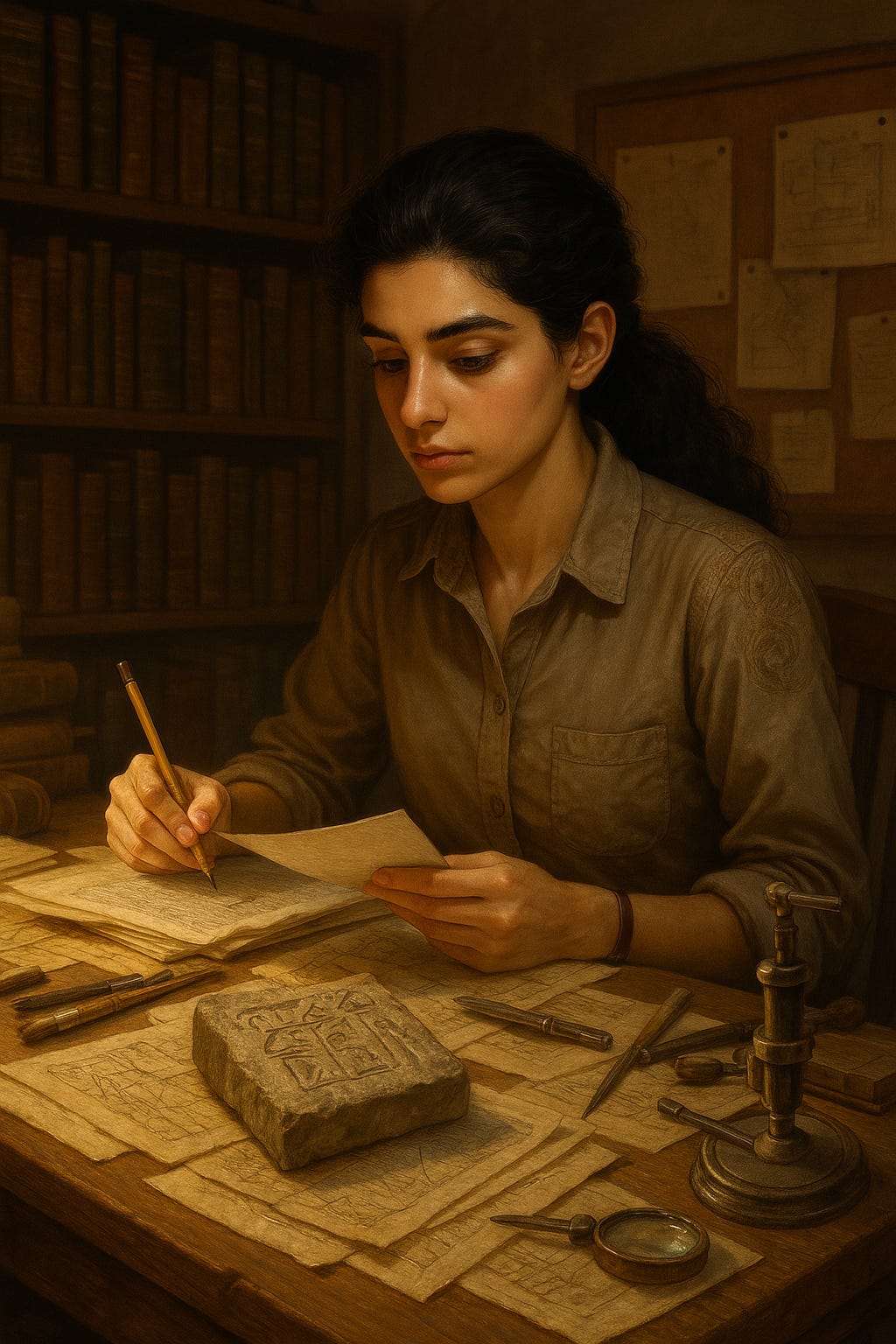
Ayesha was no ordinary graduate student. Born into a family of academics in Cairo, she was practically raised in museums and excavation sites. By the age of sixteen, she had already published her first research paper on pre-dynastic hieroglyphic evolution. Her keen eye for overlooked patterns earned her an internship with the British Museum during her undergraduate years, where she contributed to the reclassification of misidentified Nubian artifacts. After completing her master's in Ancient Civilizations at Oxford, she returned to Egypt, determined to dig where others only theorized. Her focus was on ancient symbology—especially those recurring motifs dismissed as religious abstractions. She had unearthed strange parallels between Egyptian, Indus Valley, and Mesoamerican symbols, publishing controversial but compelling hypotheses on early transcontinental knowledge exchanges. To Ayesha, archaeology was more than excavation; it was decoding humanity's buried truths.
Driven by her insatiable curiosity about recurring archetypal symbols, Ayesha had been focusing lately on enigmatic Egyptian motifs believed to link spiritual belief and astronomical alignment. Her latest endeavor involved tracking glyphs associated with the Eye of Horus and the ouroboros serpent—symbols often dismissed as mythic decoration but which she suspected held deeper cosmological significance. She believed these icons were part of a universal language of consciousness, echoing themes of rebirth, perception, and energy flow across cultures. That conviction led her to an obscure reference in a French colonial record, pointing toward an undocumented expedition near Saqqara. She flipped through a drawer marked Unverified Glyphs – North Africa, stopping at a thick envelope. The edges were faded with age. She slipped the contents onto the table: photographs from the abandoned 1920s British dig site she’d read about. This was the missing piece—proof, perhaps, that the past had encoded truths modern minds were only beginning to rediscover.
The last image caught her breath.
A stone fragment half-buried in rubble, barely distinguishable—but etched into its surface, a serpent curled tightly around an open eye. The motif had shown up numerous times in her research—on obscure artifacts misclassified as decorative, in half-erased frescoes, and on ceremonial pottery from disparate sites across the Mediterranean. But this instance was different. The carving here was deliberate, deep, and centrally framed—as if it were meant to be found, meant to declare its importance. It wasn’t listed in any database. Not in Egyptian symbology. Not Mesopotamian. Not even the speculative journals. And yet, it kept finding its way into her path.
Yes, Ayesha has seen it before.
Not in person, but repeatedly. Hidden in artifacts mislabeled as ceremonial. Scratched faintly on a ruined temple arch in Luxor. Imprinted on a pottery shard in Cyprus, of all places.
Always the serpent. Always the eye.
But this time, there was more. She zoomed in on the photo, frowning. Surrounding the serpent-eye were faint carvings—six dots arranged in a circle. Just like the ones she had overlooked in another scroll weeks ago. It was as if the symbol echoed itself across time and space, mutating but never vanishing.
She grabbed her notebook and began cross-referencing.
The pattern was emerging—and it was nothing short of strange.
***
That evening, Ayesha called her mentor, Dr. Mansour. “You know the Saqqara site that was abandoned in ’26?” she asked.
“You mean the one Lord Blakeney left after the lead archaeologist went blind?” he replied. “What about it?”
“I’ve found repeating glyphs. The same serpent-eye symbol—cropping up in entirely unrelated digs. I’ve tried to dismiss it, but the frequency and precision of its appearance are becoming impossible to ignore. It’s as though the symbol is not just decorative, but a part of a larger hidden narrative—something we haven’t yet deciphered. There’s a pattern forming, and I think it’s pointing toward something greater.”
There was a pause. “There’s someone you should speak to,” he said carefully. “A student in Cairo. Amir Khan. The name won’t mean anything to you, but his… sketches match that symbol.”
Ayesha blinked. “Sketches?”
“He’s an art student, yes, but there’s more to him. Amir has always had vivid dreams — ones he claims are unlike anything from this world. Ever since I met him during a symposium on ancient metaphysics two years ago, I’ve known he had a gift. He once told me he doesn’t just see images — he experiences entire scenes, full of symbols he later sketches with astonishing accuracy. Weeks ago, he drew the serpent-eye glyph completely unprompted, with six dots circling it. No one had shown it to him. He said it came to him in a vision that felt… higher, as if glimpsed from beyond our dimension. I think… he might be your missing piece.”
Her curiosity flared. An artist dreaming of ancient codes before she uncovered them? It sounded absurd. And yet… it also sounded too aligned to ignore.
"Ayesha," Dr. Mansour said, his voice heavier than usual, "there's something else. Amir called me again a few nights ago—middle of the night, completely shaken. He described a vision: enormous waves devouring coastlines, sirens echoing, the sky turning blood-red. He sounded terrified. Said it didn’t feel like a dream—it felt like a memory from the future."
Ayesha leaned in. "That sounds… apocalyptic."
"It is. And the worst part? His description eerily matches a prediction that’s been making rounds in fringe circles—some psychic vision shared just weeks ago. But Amir’s version had more detail, more urgency. He even mentioned the serpent-eye symbol appearing right before the wave struck."
Ayesha’s breath caught. "So the symbol isn’t just ancient... it’s a warning?"
"Possibly," Mansour said grimly. "I’m starting to think Amir’s mind is becoming a channel for something much larger than us. And if that symbol is echoing between your research and his visions—it’s not coincidence. It’s convergence."
Ayesha felt her heart clench with a complex mix of disbelief, apprehension, and responsibility. A part of her wanted to dismiss the whole affair as coincidence—a young artist haunted by symbols and dreams. But too many threads were overlapping, and her instincts had never failed her before. The serpent-eye glyph, Amir’s unexplainable accuracy, and now, visions that matched prophetic warnings. It wasn’t just academic curiosity anymore; it was a summons. She could no longer stand on the sidelines while the symbols she’d studied her whole life began to converge with real-world events. If Amir’s dreams held even a sliver of truth, they might be looking at a disaster not just foretold, but possibly preventable. She packed her bag and sent a message to Dr. Mansour confirming the meeting. Whatever came next, she knew her path had changed. The time for observation had passed. It was time to act.
Two days later, Ayesha stood at the café courtyard in downtown Cairo, watching the street for her mystery dreamer.
***
Amir approached tentatively, holding a sketchpad like a shield, his fingers clutching it like a lifeline. His eyes darted from the busy street behind him to the woman waiting with composed curiosity. When Ayesha introduced herself, his shoulders tensed—but his gaze didn’t falter. There was a flicker in his expression, a momentary tremble between familiarity and disbelief, as if reality had caught up with something long dreamt.
“I’ve seen you,” he said softly.
Ayesha arched a brow. “Excuse me?”
He flipped open the pad. A page revealed her likeness—delicately rendered but unmistakable—positioned beneath a swirling desert sky painted with ochre sands and violet hues. Her face was framed not only by windblown hair but by intricate symbols Amir had seen in his dreams: the serpent coiling protectively around an open eye, and behind them, six dots forming a circle as if to mimic constellations. The sketch exuded an eerie sense of prophecy—as if Amir hadn’t drawn what he imagined, but what had already happened in another thread of time.
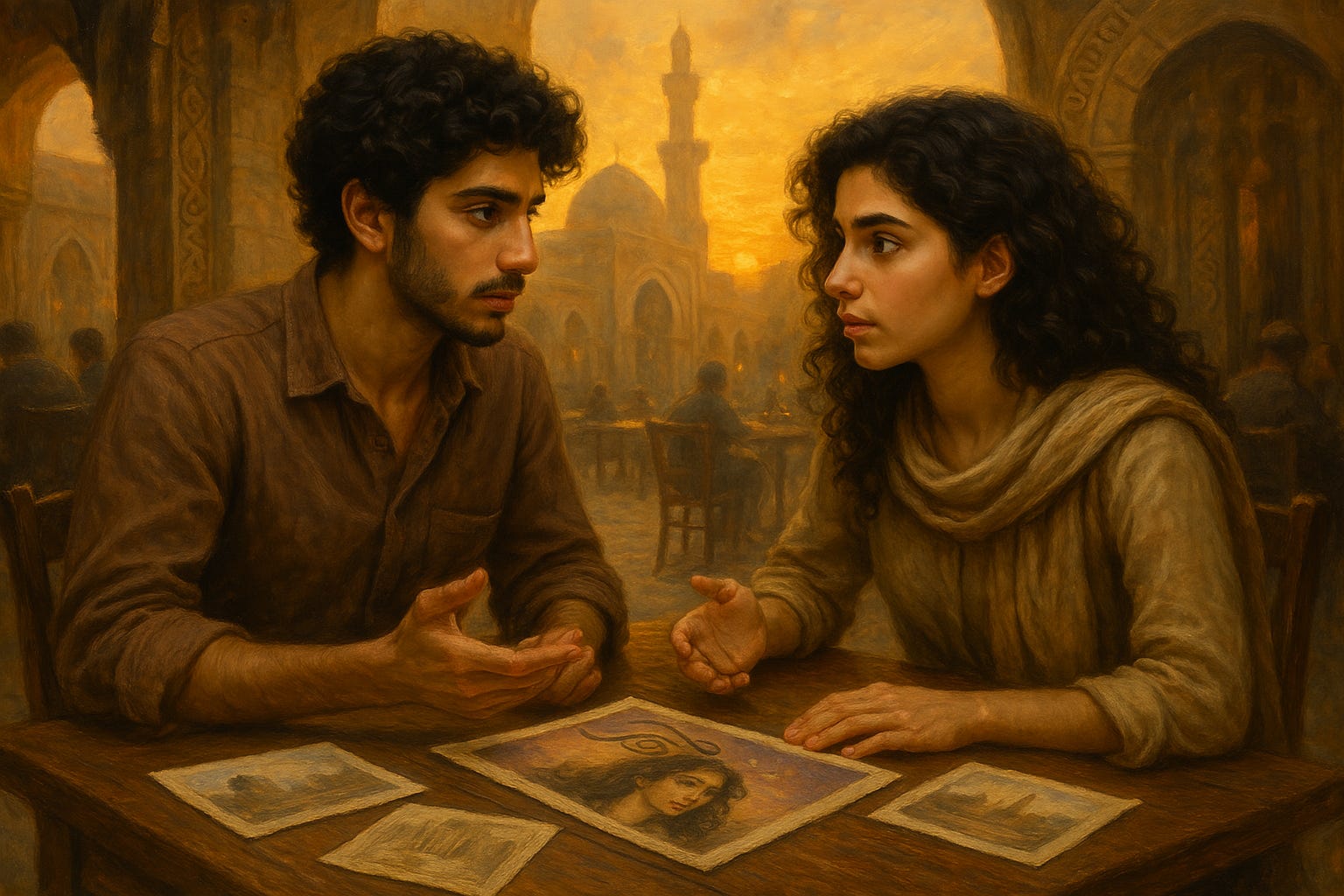
Ayesha went cold. “How… when did you draw that?”
“A month ago,” he said. “After a dream.”
They sat in silence for a moment, the hum of Cairo’s street noise feeling suddenly distant. Ayesha studied Amir’s sketch again, her fingers brushing the page as though it might offer an answer. The symbols pulled at something deep within her, something she hadn’t been able to articulate until now. Across from her, Amir watched her with eyes that held a quiet storm—uncertainty, wonder, and a trace of fear. It wasn’t just the strangeness of their meeting or the prophetic drawing that unsettled them. It was the unmistakable sense that, somehow, they were being guided. That this moment had been arranged not by chance, but by something older than time itself. The street noise returned in a wave, but between them, a sacred silence remained.
“I’ve been following the symbol,” she said. “From Saqqara, but older too. Much older. It keeps showing up where it shouldn’t.”
Amir nodded slowly, his voice low and uncertain. “It’s calling to me. Not in words, not in images I fully understand, but in a sensation—a pressure in the back of my mind, like a memory that doesn’t belong to me. Every time I dream, it gets stronger. I don’t think this symbol is just a relic. I think it’s a key, maybe to something buried… or something waiting. It feels like all my visions have been leading here, like we were meant to meet. Somehow, this moment was already written.”
Amir’s voice dropped to a whisper as he shared his latest vision. “It wasn’t just destruction. It was… inevitable. A massive tidal wave crashing through cities, people screaming, lights blinking out — not like a disaster movie, but like a memory. Like I’d seen it already happen, or was watching it from another strand of time.”
He hesitated, then added, “If fate is a river, this symbol might be a rock disrupting its flow — or maybe it’s the current itself. I don’t know. That what’s coming can’t be stopped unless we understand this thing — decode it. The symbol may be from the past, but I think it’s showing us how to reach forward. Maybe… maybe to rewrite what’s been written.”
Ayesha leaned forward. “Then we’ll start where the trail began.”
She pulled out a worn envelope and laid the photo of the broken serpent-eye carving between them.
“Near the Step Pyramid. A hidden site left unexcavated. This photo was taken hours before the expedition leader went blind.”
Amir traced the serpent in the photo with his finger. It glowed faintly under the setting sun.
As Ayesha spoke about her previous work—the long nights poring over dusty scrolls, her early publication on hieroglyphic evolution, and her controversial theory on cross-cultural symbology—Amir sat silent, hanging on every word. The clink of cups and distant murmur of the café faded for him. Her voice carried the weight of years, and he could feel how deeply she believed in the symbols they were now both entangled with. Her discoveries mirrored visions he once dismissed as madness. He nodded slowly, sensing a strange alignment, as though her scholarly path and his dreams had always been heading toward the same intersection.
A moment later, both of them reached for the same notebook.
Fate, it seemed, had already turned its gaze toward them.
Chapter 3: The Whispering Map
·Ayesha tapped the coordinates into her tablet, eyes narrowing. The buried site lay just south of the iconic Step Pyramid at Saqqara, within a restricted zone long left untouched. This area was steeped in myth—rumors among local Bedouins spoke of a hidden temple beneath the sands, cursed by ancient priests who feared its contents. Some even whispered tha…

