


Dust clung to the edges of the windowsill, filtering Cairo’s morning sun into a golden haze. Inside the small shared flat above the university campus, Amir Khan sat cross-legged, sketchpad balanced on one knee. His eyes were glazed, unblinking, lost in the space between memory and imagination. Charcoal danced in his fingers like a ritual, carving lines across the page in looping curves and jagged shadows.
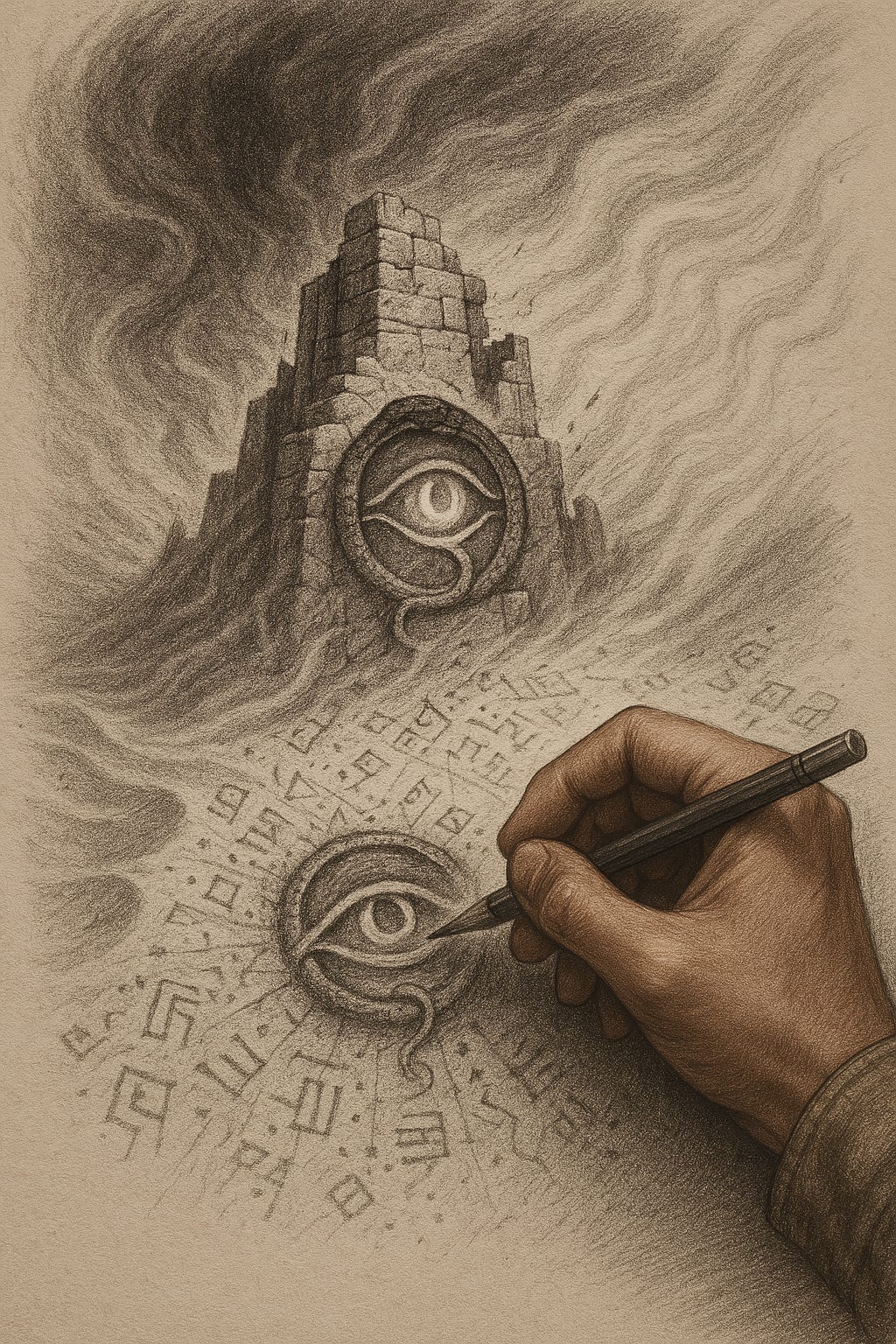
The drawing was nearly complete—a crumbling stone monument rising from dunes swept into violent spirals by a furious sandstorm. Amir’s hand moved with fevered precision, capturing every cracked edge, every worn curve of the half-buried colossus. At the center of the structure, nestled within the broken masonry, was an eerie, glowing eye. Not a literal eye, but an ancient emblem—an eye etched deep into the stone, encircled by a serpent devouring its own tail, its tail looping back to its own jaws in a perfect ouroboros.
Beneath the eye, the sand seemed almost to shimmer as if the page itself carried heat. Surrounding the symbol were fractured glyphs—fragments of an unknown script, scattered like shards of thought hurled across time. Each one was partially obscured, some carved with such fine detail Amir had to squint to capture them, others trailing off as if unfinished by their original creators. The glyphs weren’t arranged randomly; they hinted at spiraling inward, forming a cryptic constellation pointing toward the eye-serpent.
He added faint cracks spider-webbing from the eye outward, as though reality itself had once fractured at that spot. And yet, despite the violence of the storm, the monument seemed untouched—as if protected by something invisible. The more he sketched, the more he could swear the symbol was not just a relic, but a gateway. Or a warning.
“Another one?” came a voice.
Amir blinked, pulled back from the page. His roommate, Kamal, leaned in the doorway holding a coffee, eyeing the sketch warily.
“You’re starting to worry me, bro,” Kamal said. “That’s the third one this week.”
Amir offered a tired smile. “I just… dreamt it. Again.”
Since he was a child, Amir's dreams were vivid and often unsettling—visions of places he had never seen, events that hadn’t yet happened. Over time, patterns emerged. Faces of strangers became acquaintances, future conversations echoed in reality. He began sketching what he saw, the drawings acting as both relief and record. But no matter how many he completed, the dreams kept coming—stronger, more precise, more urgent.
His family believed he had been born under a rare astrological alignment, one that aligned the moon with the star Regulus—a sign of visionary sensitivity in their ancestral Sufi traditions. While they chalked it up to poetic superstition, Amir had always sensed something deeper. Spiritual traditions linked this kind of vision to the third eye, the ajna chakra—the seat of intuition and insight. In Hindu mysticism, it was said to be the gateway between the physical and the spiritual realms, a connection to universal consciousness. Amir wasn’t sure if he believed in all of it, but he couldn’t deny the pressure he felt behind his brow during each vision—like a soft vibration, or a tuning fork humming inside his skull.
“You need sleep, not visions. Come to the bazaar with me today. You’ve got to stop brooding over this weird prophecy stuff.”
“I can’t,” Amir muttered. “Every time I close my eyes, it’s clearer. This place—this symbol—it’s real. I can feel it calling.”
Kamal shook his head and walked away, muttering something about incense and overactive imaginations. But Amir knew what he felt wasn’t imagination. Sometimes déjà vu. Sometimes knowing who would knock on the door before it happened. Once, years ago, he had drawn a woman’s face from a dream—and months later, he met her during a university visit to Jaipur. She had been wearing the same scarf.
More recently, his visions began to show symbols—interlocking glyphs, star maps, ancient eyes wrapped in serpents—that no book could explain. They felt like echoes from another plane, as if time had folded briefly and allowed him to glimpse a sliver of something far beyond human comprehension.
He didn’t know what it was. Only that something inside him stirred when the visions came. A pressure behind the forehead, between the brows, pulsing like a drumbeat from another world.
Lately, it had been growing louder.
***
The night before, Amir had fallen asleep to a strange rhythm—like whispers carried on wind through stone corridors, threading into his subconscious like ancient chants. In the dream, he was walking barefoot across a desert that pulsed beneath his feet, as if alive. The sands shimmered with heat, yet the wind was cold, whispering secrets in tongues he didn’t recognize. A storm loomed on the horizon, not of mere weather, but of something vast and sentient—lightning crackling in unnatural hues of violet and gold, painting the clouds in cosmic shapes.
He trudged forward, drawn by an unseen pull, until he crested a dune and saw it—a carved stone monument, immense and half-buried. Its surface was etched in symbols that seemed to move when he blinked, like shifting thoughts frozen in stone. Though he had never seen it in waking life, the monument sparked a raw, unplaceable emotion in him. Not awe, not fear, but a powerful familiarity that made his heart race.
It wasn’t grandeur that struck him, but déjà vu—an echo of a forgotten memory. He had stood here before, perhaps in another life.
The wind howled, and in its mournful cry, he heard a voice—not in words, but in understanding: “Awaken, Seer. The gate stirs beneath the sand.”
That was when the eye lit up—bright, searing, almost too vivid to look at. It pulsed not with ordinary light, but with something deeper, older—an illumination of pure knowing. As if a thousand forgotten truths were compressed into a single radiant pulse and fired directly into his mind. The symbol blazed like a miniature sun, but instead of burning, it revealed: layers of memory not his own, glimpses of time unraveling and reforming, and an overwhelming sense of having just glimpsed the edge of something cosmic. Not a vision, but an unveiling.
He had awoken gasping, drenched in sweat, heart hammering with awe and terror, his hands already moving toward the sketchpad as if possessed by a truth too urgent to forget.
Now, as he stared at the finished image, a shiver crawled down his spine. He had added something unconsciously—a set of six tiny dots circling the eye, barely visible. He didn’t know what they meant.
Not yet.
***
That afternoon, unable to sit still, Amir wandered into the hushed stillness of the university archives, his pulse quick with a strange urgency. He combed through yellowing photographs and brittle expedition notes, chasing a thread he couldn't name. He scanned images from dozens of Egyptian digs, cataloged and uncatalogued, until one photo, creased and faded from age, caught his eye.
It was from a 1922 expedition near Saqqara—the same year Howard Carter discovered Tutankhamun's tomb, a year steeped in myth and mystery. In the grainy print, barely visible on a fractured sandstone slab, was a symbol Amir thought only existed in his dreams: a coiled serpent surrounding an orb. But it wasn’t just the form—it was the placement. The orb appeared embedded at the convergence point of a star map etched faintly across the surface, lines so subtle they looked like cracks to the untrained eye.
His breath hitched. The caption read: "Uncatalogued. Believed to be ceremonial. Origin unconfirmed."
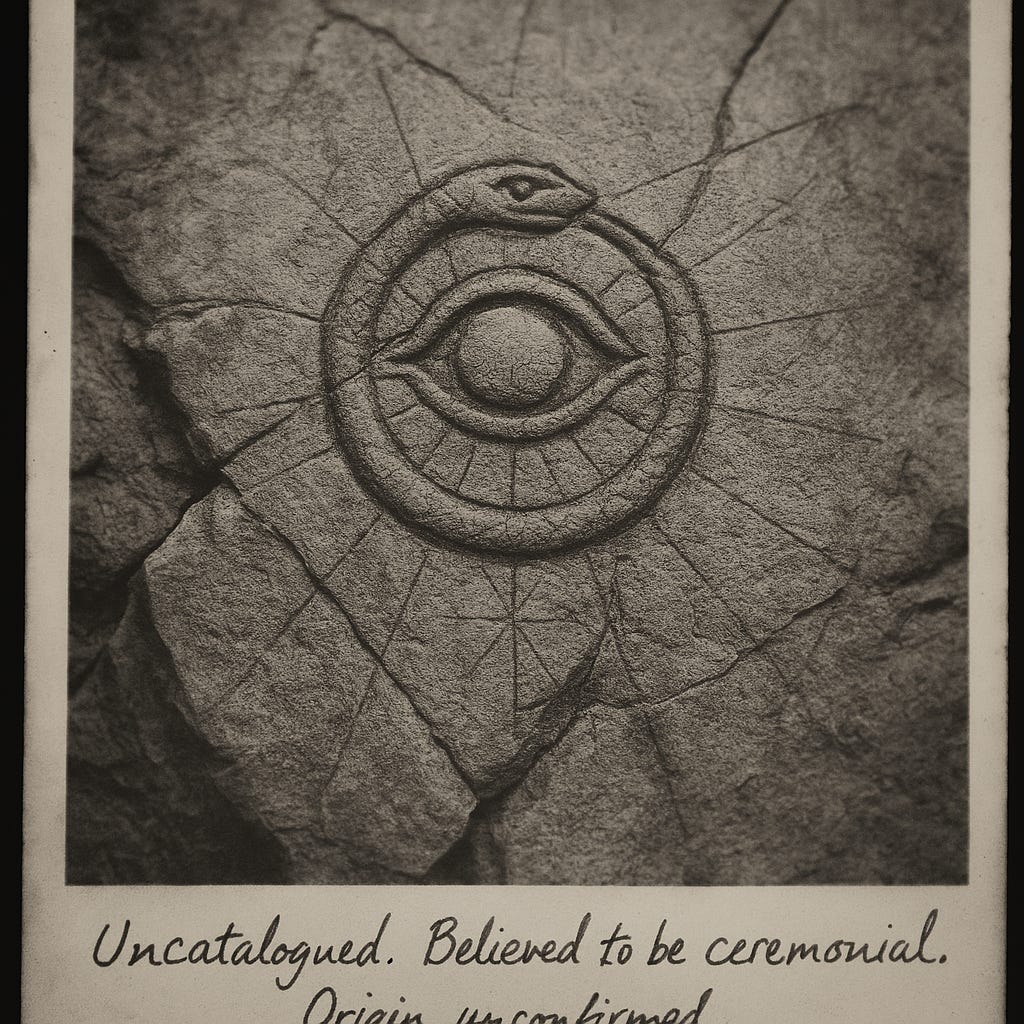
He took a photo with shaking hands and staggered out into the evening air, heart pounding. What was this symbol doing buried in a real archaeological record? Why did it match the patterns he'd seen in dreams since childhood? Something ancient was pressing through the veil of time—and it was calling him by name.
Back in his room, he pinned the photo next to his sketch. The resemblance was undeniable.
He rubbed his brow. That strange pressure again. Not pain exactly, but like something waiting to be let out. It was as if a door inside his mind stood barely ajar—light pouring through the cracks, waiting to burst open. Amir had felt this sensation before, always preceding a revelation in his dreams. It wasn’t physical. It was more like a presence—a conscious pulse behind his forehead, as though reality was nudging him toward a hidden truth. He couldn't shake the feeling that the visions weren't random. They were pieces of something grand, something meticulously placed in his path. Deep inside, he believed he wasn’t just remembering these dreams; he was being shown them. Each image was a breadcrumb, each symbol a whisper from something beyond. And now, with the photograph confirming the symbol’s real-world existence, it felt like the final veil was thinning. The dreams had led him here—for this moment. For a reveal.
As the sun set behind Cairo’s rooftops, Amir sat silently before the sketches, eyes half-closed. Now, with the pieces converging and the pressure behind his brow intensifying, Amir felt a pull stronger than coincidence. A name surfaced in his thoughts — a visiting archaeology scholar from Alexandria whom Amir had briefly met during a university lecture two years ago. They had exchanged only a few words, but something about the professor’s fascination with symbolic parallels across ancient civilizations had stayed with Amir. If anyone could help decode this mystery, it was him.
Somewhere beneath the sands of Egypt, a secret was stirring.
And he was meant to find it.
Chapter 2: The Forgotten Glyph
·The basement of the Antiquities Research Department at Alexandria University always smelled like dust and forgotten time. Ayesha Hassan relished it. Between the brittle scrolls and yellowed prints, she felt more at ease than among any crowd above ground.
