


The early light of dawn barely reached the stone reliefs as Amir and Ayesha ducked through the low arch. Nestled into a sandstone outcrop a short trek from the excavation site was the so-called “Shrine of the Turning Eye”—a structure locals had long avoided, calling it Al-Ayn al-Latifa, “The Gentle Eye.”
Except there was nothing gentle about the place.
Goats wouldn't graze near it. Nomads refused to set camp within its shadow.
But to Ayesha, it was a relic of untouched knowledge.
The inside was carved with cosmic geometry—spirals, stars, intersecting lines radiating from an all-seeing eye motif. But it was the wall at the far end that made Amir stumble.
The Eye of Horus.
"The symbol," said Amir, his voice trembling slightly.
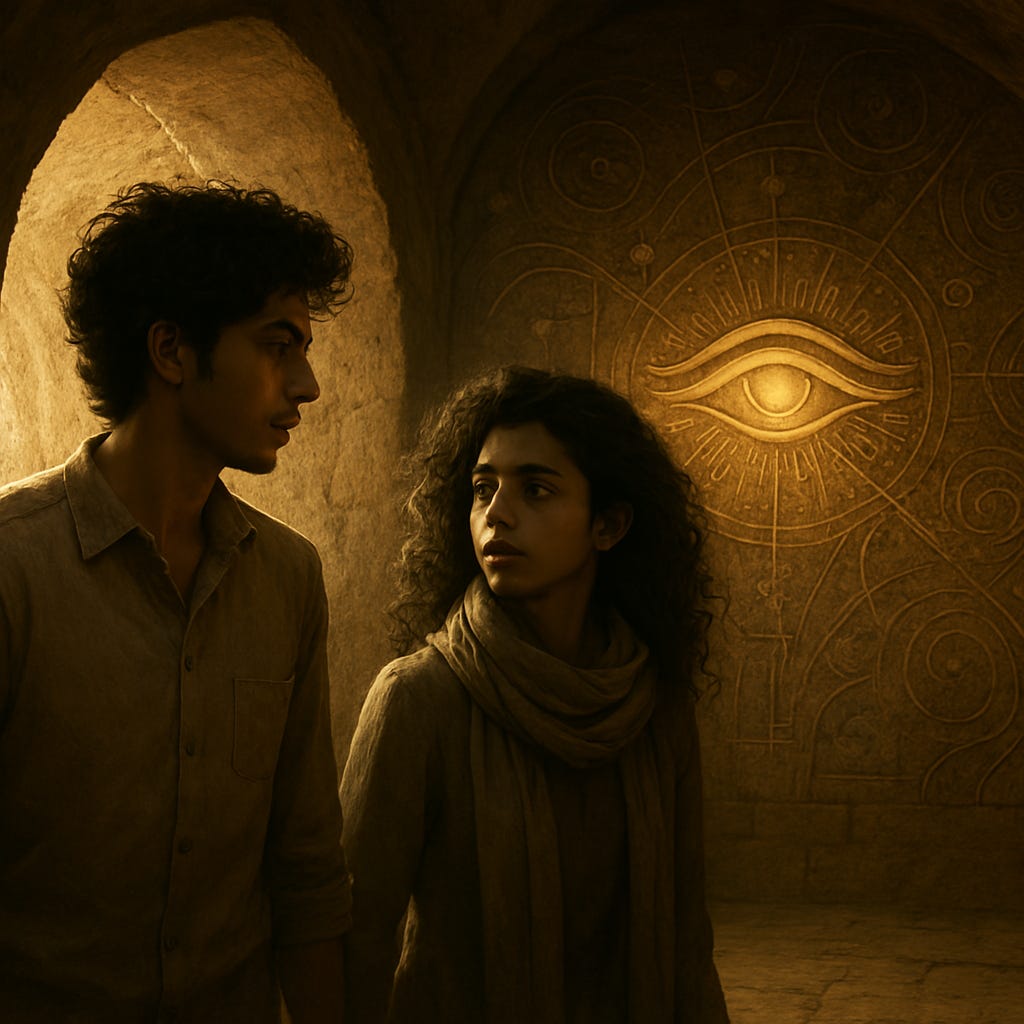
Ayesha took a breath and knelt beside the carved Eye of Horus, her fingers tracing its outline. "The Eye of Horus, also called the Wedjat, isn’t just an icon of protection," she began. "It represents spiritual insight—clarity beyond ordinary perception. The ancients believed it could see through illusion, into the heart of truth."
She glanced at Amir. "Some scholars say the Eye mirrors the anatomy of the human brain. Look—" she pointed—"this curve aligns with the thalamus, this with the pineal gland. That’s why some link it to the 'third eye'—the seat of intuition, or in yogic terms, the Ajna chakra."
Amir’s gaze darkened, his pulse quickening. Ayesha continued, "That spiral beneath it? Serpent energy—Kundalini—coiling at the base of the spine and rising. When it reaches the pineal gland, it 'activates' the third eye, triggering visions."
She looked him in the eye. "That’s why I think your dreams aren’t just dreams. You may be seeing something from beyond—perhaps from another dimension, another time. The Eye... it could be resonating with you."
Amir recalled the Hindu tradition of the red bindi—a mark placed on the forehead, between the eyebrows. In many Indian cultures, it symbolizes the third eye, the spiritual center of perception and intuition. He thought of how similar the symbolism was to what Ayesha described. Could this ancient connection be more than metaphor? Perhaps his visions weren't madness or coincidence, but a reawakening of something deeply encoded in human consciousness across civilizations.
He turned back to the glowing glyphs, a strange pressure behind his brow. "Or it could be warning me... that the veil is thinner than I thought."
Beneath the Eye — not standard hieroglyphs. Instead, two horizontal paths carved beneath the eye—one leading toward a serpent swallowing its own tail, the other to a star split down the middle.
Ayesha knelt before the symbol. “It’s the same dual path from your vision,” she whispered. “This is the riddle.”
“It’s a choice,” Amir said, voice flat. “Serpent or star.”
***
They camped near the shrine that night, their small tent set up under the shadow of the turning stone. Ayesha pored over the tablet renderings by lantern light, the glow flickering across the etched serpent and star. Her fingers moved restlessly between the pages of notes and photographs, trying to reconcile meanings that seemed just beyond reach. Amir, meanwhile, sat silently by the fire, arms wrapped around his knees, his face pale and drawn. Every so often, he’d glance toward the shrine, as if expecting it to shift again, to speak. The events of the day haunted him—especially the eye, the light, and the mechanism. The fire crackled, throwing strange shadows that danced like omens. Ayesha looked over once, watching him trace something into the dirt with a stick—a spiral, then a star. The same riddle. The same dread. Though no words passed between them, a shared sense of urgency and unease permeated the air, thick as the desert night.
“I’ve seen this before,” he said suddenly.
Ayesha looked up.
“In my dreams, that symbol… it always splits in two. One path shows the serpent coiling around me like it’s part of me, winding tighter, almost protective—almost. The other path leads to a falling star, a blinding descent that feels like a final warning." He drew a shallow breath. "In both… there’s a cost. I lose something—myself, maybe. Or something I haven’t yet found.”
Ayesha leaned forward, her eyes flicking between the serpent and the star. “What if it’s all metaphor?” she said quietly. “The serpent has always symbolized hidden wisdom—Kundalini, yes—but across cultures it shifts. In Egyptian lore, it guards thresholds. In Greek mythology, the caduceus—a staff with two serpents coiling upward—was carried by Hermes, the guide of souls. Some say it represents healing. Others say duality, balance, or deceit.”
She gestured to the star above it. “And the star… light without grounding. Maybe it’s the pursuit of truth, but fractured. Divided. Without the grounding wisdom of the serpent, it leads only to collapse.”
Amir watched her, brow furrowed. “So it’s not about good or evil.”
“No,” she said. “It’s about interpretation. The same symbols are seen as divine or destructive depending on the lens. Maybe the riddle isn’t about choosing the right path, but understanding the paths are mirrors of each other—both dangerous, both enlightening. That winding serpent path might be terrifying, but it could also be the one that transforms us.”
“But what if it’s a warning denying us pressing forward?” Amir countered. “The serpent does consume.”
They stared at the fire. Two minds, both intelligent, both haunted. The weight of the riddle bore down between them like sand pressing on a buried tomb.
Neither was ready to admit they were afraid.
***
At 3:18 AM, Sirius breached the horizon. A blindingly blue twinkle in a sea of darkness.
The shrine responded.
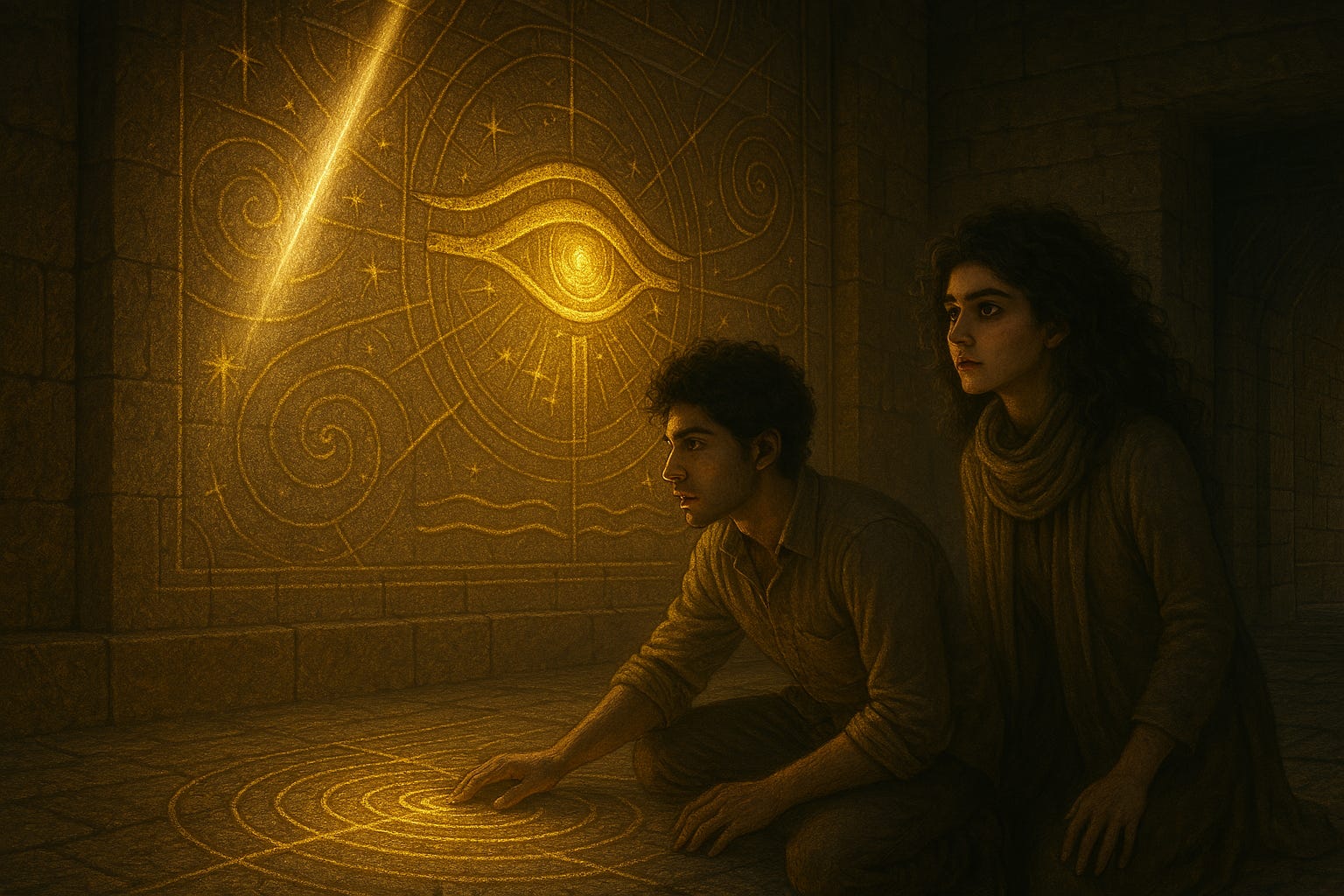
A beam of light—faint but real—passed through a thin slit in the stonework and struck the Eye of Horus. The Eye responded like a living conduit, its carved lines suddenly radiant, pulsing with a golden hue as though ancient energies had been reawakened. The dual paths beneath it shimmered, casting reflections across the chamber walls. The dormant energy now flowed visibly through the carvings, weaving intricate patterns that glowed in synchronicity with Amir’s breath. The moment felt suspended in time, as if the stone itself was whispering truths from another dimension. A hush settled over them. Something sacred had stirred.
In the dust below the eye, a spiral-shaped mechanism clicked.
Amir knelt beside it. “This wasn’t a temple all along. It was a mechanism.”
“More like a calendar,” Ayesha breathed. “Marking when the stars align.”
The wall began to shift.
Stone grated on stone, releasing a deep, guttural echo as a narrow vertical shaft revealed itself beneath the shifting wall. The passage descended steeply, carved with unnerving precision into the limestone bedrock, its edges marked by faint tool marks as if made by hands millennia old. A breath of air rushed out to greet them—cool and heavy, steeped in forgotten centuries. It carried the scent of old parchment and decaying linen, mingled with traces of burnt herbs, frankincense perhaps, and the sterile bitterness of dust untouched by time. The silence that followed was thick and unyielding, broken only by the subtle sound of sand trickling into the darkness below. Amir and Ayesha stood still, absorbing the weight of the moment. Whatever lay beneath had been sealed not just by stone, but by purpose.
Amir and Ayesha exchanged a glance.
The tomb that the dual was led by fate to discover, had opened.
Chapter 5: Door of Sand
·Their torches flickered as Amir and Ayesha stepped into the shaft. The stone walls were smoother than expected—etched not with crude chisel marks, but precise lines forming layered spirals and concentric circles, as though a cosmic equation had been carved into the earth itself.


